

af Magazine
~The Asahi Glass Foundation’s web magazine on the global environment~


"Nature Is Capital That Supports the Economy": Professor Barbier, the Economist Who Helped Lay the Foundations of the Green Economy
Professor Edward Barbier has consistently stood close to the poor, conducting field research and translating his findings into policy recommendations. He helped create a movement to incorporate the value of nature and ecosystems into the economy, and has had a major global impact through the idea of a "green economy" and the policy proposal known as the "Global Green New Deal." When he began his career, environmental economics applied to developing countries did not yet even exist as a field. How, then, was Professor Barbier able to leave such important achievements? We asked him about his work.
(Interview recorded on June 11, 2026.)
How Do Poor People Survive?:A Childhood Question as the Starting Point

"I think there are three areas where I have made contributions through my career. The first is understanding poverty-environment linkages. The second is the role of nature in supporting economies and livelihoods. And the third is how we transition our economies to a more environmentally sustainable and prosperous path."
This is how Professor Edward Barbier, laureate of the 2026 Blue Planet Prize, describes his own achievements. These contributions also show that Professor Barbier has been a rare scientist capable of bridging different worlds: developing and developed countries, ecology and economics, and science and policy.
Professor Barbier is a pioneer who has continued to explain the value of nature in the language of economics. It may come as a surprise that the starting point of his work was a "simple curiosity" he had in childhood.
Because his father was a diplomat at the U.S. Embassy, Professor Barbier spent most of the years from his birth until the age of twelve in countries across Southeast Asia. Looking back, he says, "As a child, I was surrounded by rural poverty."
"One question stayed with me: How were these people surviving? They had no jobs, no opportunities to escape poverty, and no savings. Even as a child, the answer I reached was obvious from what I could see with my own eyes: they were using nature."
That realization greatly changed Professor Barbier's view of nature. He came to see nature as a form of capital, a store of wealth, and a provider of services that support the livelihoods of the poor.
"Mangrove forests and wetlands provided fuelwood, food and protected people from storms. Rural life clearly showed the economic role that nature plays, and it left a strong impression on me. But at the time, neither economics nor environmental science was paying attention to these connections."
Meeting Professor Dasgupta:Toward the View of Nature as Capital

After entering Yale University, Professor Barbier turned his attention to the role of natural resources in developing countries. How were countries rich in natural resources using them for long-term economic development? To explore this question, he returned to Indonesia to conduct research.
A major encounter then came during his master's program at the London School of Economics: his meeting with Professor Partha Dasgupta, the 2015 Blue Planet Prize laureate. As Professor Barbier studied "development economics" under Professor Dasgupta, and, the two discovered a shared deep interest in resource problems in developing countries and engaged in many discussions.
"At the time, economics already discussed natural resources such as fish, fossil fuels, and land as forms of capital. But I wanted to take that a step further and ask whether nature as a whole could be viewed as a form of capital, providing income and benefits just as conventional natural resources do."
His doctoral dissertation contained another important core argument: the concept of "ecological scarcity." As economies grow and material wealth increases, the services and value that nature provides are often lost or damaged. Professor Barbier understood this trade-off as the problem of "ecological scarcity in growing economies." In his dissertation, he emphasized that this was an economic problem as important as the depletion of fossil fuels or the loss of fisheries resources.
As the Organization's Only Economist:Learning from Ecologists in Institutions and in the Field

After completing his doctoral studies, in 1986 Professor Barbier joined the International Institute for Environment and Development (IIED), an international independent policy think tank and laureate of the 1992 Blue Planet Prize. IIED's mission was to connect environmental problems with the challenges of developing countries and to deliver research findings to international organizations such as the United Nations and to national governments.
"At the time, the head of IIED, Richard Sandbrook, was determined to bring economics into environment and development. That is why he hired me, even though I was just starting out as an economist. There were very few economists working in this field. Because I had to take on everything myself—poverty and the environment, climate change, natural resources and economic development, and the sustainability of economies—I naturally gained a broad perspective."
While working at IIED and conducting research in developing countries, one of Professor Barbier's greatest assets was meeting researchers from other fields.
"My colleagues at IIED were all excellent researchers who were serious about real-world problems. They were not academics building theories in isolation; they were practical researchers from many fields who wanted to solve problems. Early in my career, I was strongly influenced by fields outside economics, especially ecology. I was greatly helped by perspectives on resilience and by careful research into specific ecosystems."
Ecologists had shown that mangrove forests serve as spawning and nursery grounds for fish, as breakwaters protecting coasts from storms and storm surges, and as direct support for the livelihoods of poor people. Building on these findings and studying them from an economic perspective opened up a new academic field.
In 1988, Professor Barbier joined with economists Professors David Pearce and Anil Markandya of University College London to form the London Environmental Economics Centre (LEEC), which was housed at IIED. David Pearce was the first Director of LEEC, and Professor Barbier became Director in 1990. Professor Joanne Burgess, who is Professor Barbier's wife, became a researcher at LEEC in 1988. Throughout this period, the work of the London Environmental Economics Centre broadened our understanding of how economics can bridge environment and development challenges and achieve transitions to a green economy. The success of LEEC contributed to IIED receiving the 1992 Blue Planet Prize.
Discussing with Blue Planet Prize Laureates:The Culmination in a 1994 Book
Professor Barbier's days at IIED were directly reflected in his approach as a researcher. He became a bridge—someone who crosses and connects different worlds.
In the early 1990s, an interdisciplinary group of ecologists and economists was formed at the Beijer Institute of Ecological Economics of the Royal Swedish Academy of Sciences. The group brought together researchers from the two disciplines to discuss the relationship between ecology and economics. Professor Dasgupta and Karl-Göran Mäler, both economists, played leading roles in the group, and its meetings were characterized by lively and wide-ranging discussions. As a young economist, Professor Barbier participated in almost every meeting from the group's inception.
Many members of this group would later become Blue Planet Prize laureates: Professor Robert Costanza (2024), Professor Brian Walker (2018), Professor Gretchen C. Daily (2017), and others. This intellectual community and network, where researchers brought their knowledge together, became a foundation that supported their work.
After the first set of Beijer meetings on biodiversity, Professors Dasgupta and Maler visited Professor Barbier.
"They said, "We would like you to bring these discussions together in a book. You are able to translate technical knowledge into practical language. You are also good at synthesizing ideas from different disciplines."
In response, Professor Barbier wrote a book together with Professor Joanne Burgess, his wife, and Professor Carl Folke. That book was Paradise Lost? The Ecological Economics of Biodiversity, published in 1994.
"The book contains all the ideas that shape environmental economics today: the concept of ecosystem services, in which ecosystems provide benefits to economies and people; the perspective of ecosystems as natural capital; and the idea of ecological scarcity, which I have repeatedly emphasized. It was truly a groundbreaking work that brought together insights from ecology, the social sciences, and many other fields, while reframing biodiversity through the lens of economics."
The "Global Green New Deal" That Moved the World
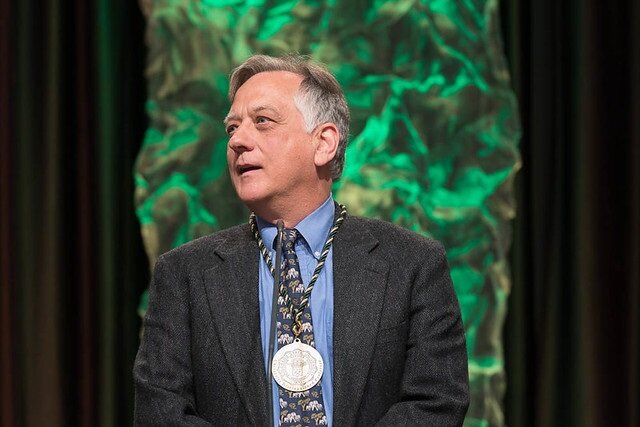
Professor Barbier has a rule he sets for himself: "My work must be academically sound, but it must also be useful in the actual policy arena." His experience working at IIED and the London Environmental Economics Centre allowed him to explore and present a picture of what a sustainable economy should look like.
The sustainable economy that Professor Barbier and his colleagues presented was the "green economy." Blueprint for a Green Economy (1989), co-authored with Professor David Pearce and others, influenced many scientists and policy experts. About twenty years later, against the backdrop of the 2008 global financial crisis, the international community began discussing how economic recovery should be achieved in a green way. At the request of the United Nations Environment Programme (UNEP), Professor Barbier wrote A Global Green New Deal (hereafter GGND) in 2009.
In the report, following the example of President Roosevelt's New Deal, Professor Barbier strongly proposed that governments actively intervene—not to rebuild the old "brown" economy, but to steer the world economy toward a "green" one while promoting economic growth and employment.
"The GGND accomplished two things. First, it helped popularize the concept of the green economy in international policy discussions. In 2018 and 2019, U.S. Congresswoman Alexandria Ocasio-Cortez vigorously promoted a Green New Deal, and Europe has actually adopted policies bearing that name. The idea took root globally that policies using economic tools such as incentives and regulations could promote the transition from fossil fuels to clean energy."
The GGND also brought about another important change in the world. It helped mainstream the idea among international organizations and policymakers that the pathways to sustainable development differ between developing and developed countries.
"For developing countries, sustainable development means eliminating poverty while wisely managing and using their natural resources. For developed countries, it means moving away from dependence on fossil fuels and transitioning to clean technologies. I also emphasized that the GGND should be promoted through the G20, bringing together not only developed countries but also emerging and developing countries."
The GGND can be seen as an achievement of Professor Barbier's role as a bridge between research and policy. And by showing that developing countries have their own path, it also reflected the same attention to poor people that he has had since childhood.
Three Messages for Japanese Readers from Professor Barbier
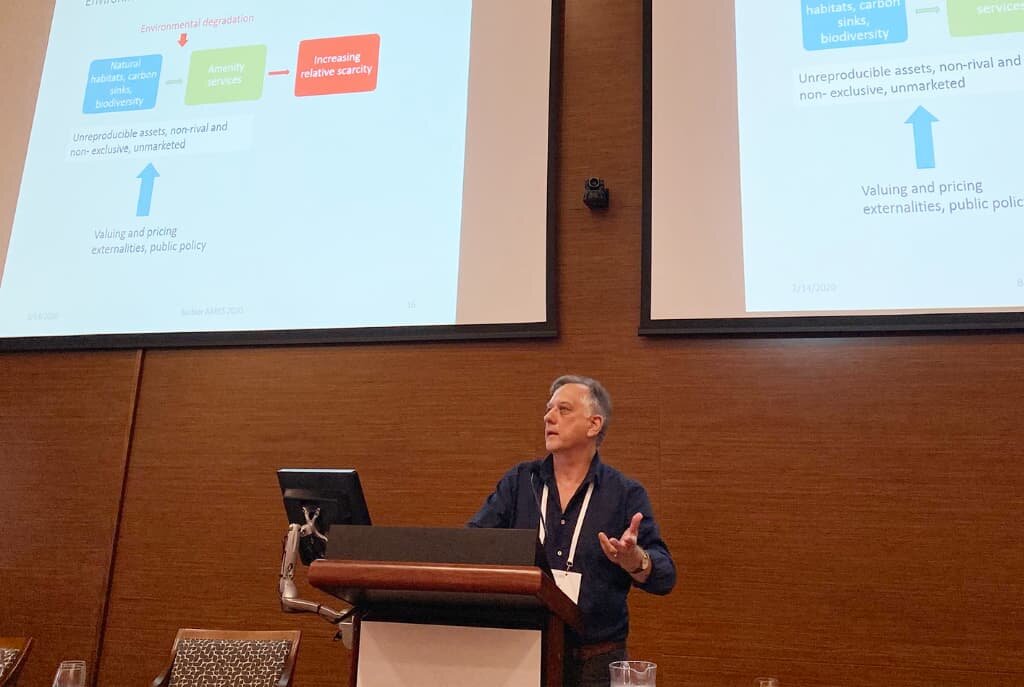
Today, the value of nature is beginning to be incorporated into the economy. For example, the Taskforce on Nature-related Financial Disclosures (TNFD), an international framework that asks companies to disclose how their activities affect and depend on the natural environment, had 711 participating companies worldwide as of July 2025, with 180 Japanese companies—the largest number by country. In Japan, the Sustainability Standards Board of Japan (SSBJ) standards for listed companies were also published in 2025, and movement toward mandatory disclosure is accelerating.
Professor Barbier says he feels hopeful that the business and financial sectors are beginning to receive his message.
"First, there is the recognition that nature is a form of capital and directly affects corporate profits, lending, and investment. Second, there is the recognition that environmental risks—such as water scarcity, climate change, ocean degradation, and biodiversity loss—are also business risks. These ideas are steadily taking root in companies. My latest book, Economics for a Fragile Planet (2022), has also been well received by the business community, and I feel that this way of thinking is beginning to be accepted in business practice."
At the same time, Professor Barbier points out that nature is still treated as less valuable than other economic assets, and that governments continue to subsidize industries that harm the environment. What concerns him most now is that rising nationalism is obstructing collective action on shared environmental problems. The leader he hopes will help break through this situation is Japan.
"I have expectations for Japan's leadership as an island nation that understands the need for international cooperation. And it is the power of each person living in Japan that moves the government. Please continue to encourage the Japanese government to act. I also hope Japanese businesses will become leaders in innovation in energy-saving technologies and in driving the reduction of fossil fuels."
"Japan has a long and rich history and culture. Please do not forget to take a long-term perspective. I hope Japan will combine the wisdom of the past with the technologies of the future and show the world a sustainable way forward. I believe the people of Japan can do it."
The path to a green economy shown by Professor Barbier seeks to achieve economic growth, employment, poverty eradication, and the sustainability of nature. We are now moving forward, little by little, toward an ideal future for humanity.
Profile
Professor Edward Barbier (USA)
University Distinguished Professor, Department of Economics, Colorado State University
2026 Blue Planet Prize Laureate
Professor Barbier has led efforts to value natural capital and ecosystem services, providing concrete guidance for policy and investment. In his UNEP report A Global Green New Deal (2009), he presented a recovery strategy integrating economic revitalization, poverty reduction, decarbonization, and ecosystem protection, and has since redefined nature conservation as a "strategic investment" for economic prosperity. Through his analysis of poverty-environment linkages, he has further outlined how to reconcile global environmental concerns with social equity.